
GreenEDU third newsletter
December 2025
Introduction
GreenEDU implementation activities and other relevant events aim to support HE (Higher Education) educators and students in developing green and digital skills that will allow them to participate in the green economy once they graduate, which will allow them to fight environmental degradation. Finally, promotional activities and 4 events will be organized to further disseminate the project and its results. GreenEDU is co-funded by the Erasmus+ program of the European Union.
Get in touch with us to know more! Check out our website here

Co-Funded by the European Union. Views and opinions expressed are however those of the author(s) only and do not necessarily reflect those of the European Union or the Foundation for the Development of the Education System (FRSE). Neither the European Union nor FRSE can be held responsible for them.
Partners Spotlight
University of Tartu
The University of Tartu is the oldest and largest higher education institution in Estonia. Established in 1632, it has been the centre of Estonian academic life for almost four centuries. It is among the 1% of the world’s most cited universities and research institutions in 15 fields of research. The university has four faculties: the Faculty of Arts and Humanities, the Faculty of Social Sciences, the Faculty of Medicine, and the Faculty of Science and Technology. There are 15,200 students (incl. around 1,600 international students) and 3,700 staff members.
The GreenEDU team is based at the Centre for Applied Social Sciences (CASS), where we offer high-quality applied research and analyses for societal issues. Our purpose is to raise the importance of sustainable strategic planning based on expert knowledge.

The University of Tartu participates in all GreenEDU activities. Currently, we are involved in developing the GreenEDU curriculum in the areas of „embodying sustainability values“ and „acting for sustainability“. The University of Tartu also leads GreenEDU communication and dissemination. We manage the strategic communication, communicate the progress through newsletters, website and social media, and develop any dissemination materials.
Event Highlights
Third official meeting
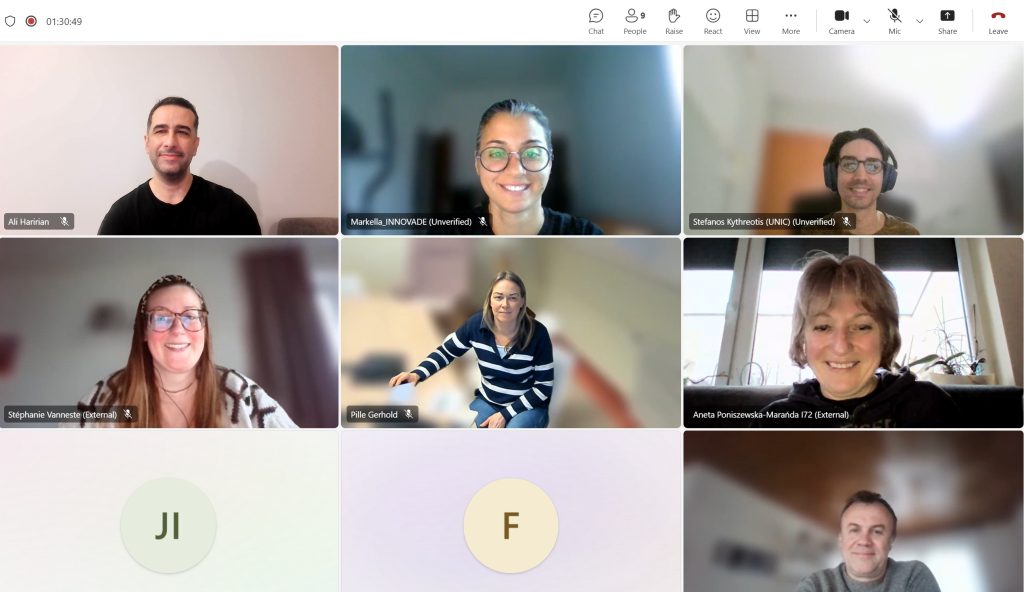
Our 3rd online meeting took place on 24/11/2025, hosted by the project’s lead partner Lodz University of Technology, Poland (TUL). Where all the partners presented their work packages and updates on the progress.
Work in progress
e-Toolkit
The e-Toolkit has been developed by the GreenEDU Consortium Partners. Its objective is to create a space where HE educators, HE staff, leaders, and other relevant stakeholders can access knowledge and experience to inform their own work. The e-Toolkit contains information to help the aforementioned target audience understand the what and how of incorporating green skills in HE curricula, and gain knowledge on using Augmented Reality (AR) tools to assist them in teaching these green skills and making learning more fun and interactive. You can download the PDF version of the e-Toolkit using the button below:
GreenEDU Curriculum Update
Developing Innovative Green Skills Education Across Europe
The GreenEDU project is progressing rapidly, with international teams co-creating a sustainability curriculum for higher education. Led by Vives University of Applied Sciences, Work Package 3 develops an interactive learning journey that prepares students for the green economy.
What is the GreenEDU Curriculum?
The curriculum strengthens green skills through the 12 GreenComp competences, grouped into four areas: sustainability values, systems thinking, future thinking, and action for sustainability. Each module also connects to the SDGs, EntreComp4Transition, and green business principles, offering both conceptual understanding and practical skills.
How We Design Learning
We combine Merrill’s First Principles with Design Thinking to create engaging, problem-centered, and creative learning experiences. Augmented Reality further supports understanding by visualizing complex sustainability issues and allowing students to explore the impact of their choices.
Current Progress
Cross-national teams are now developing lesson packages and AR activities, integrating diverse European perspectives. Together, we are building a curriculum that empowers students to understand complexity, imagine sustainable futures, and take meaningful action.